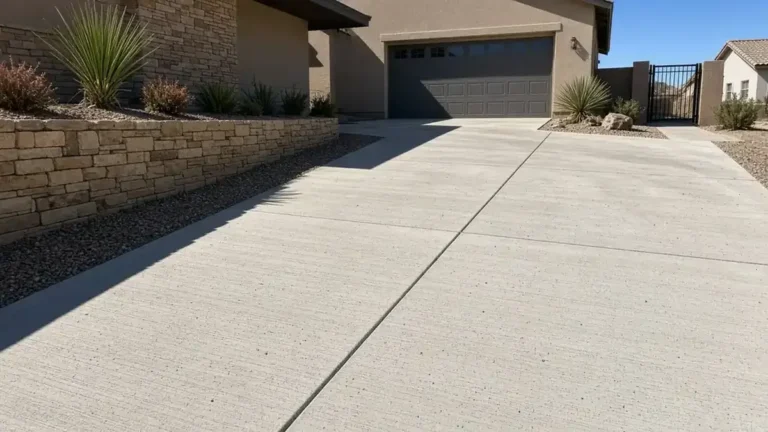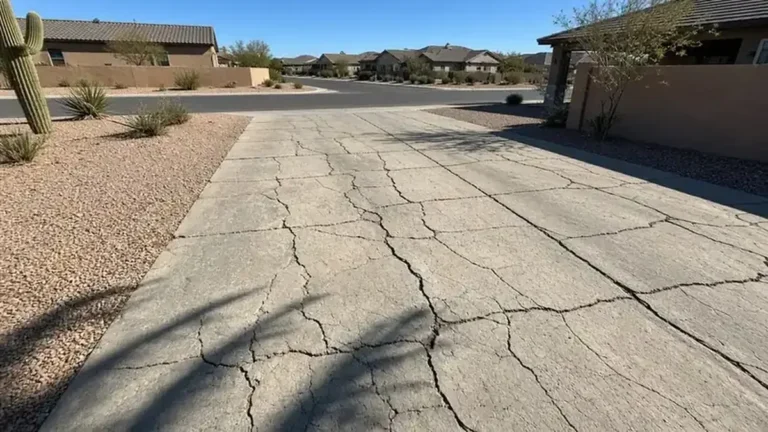
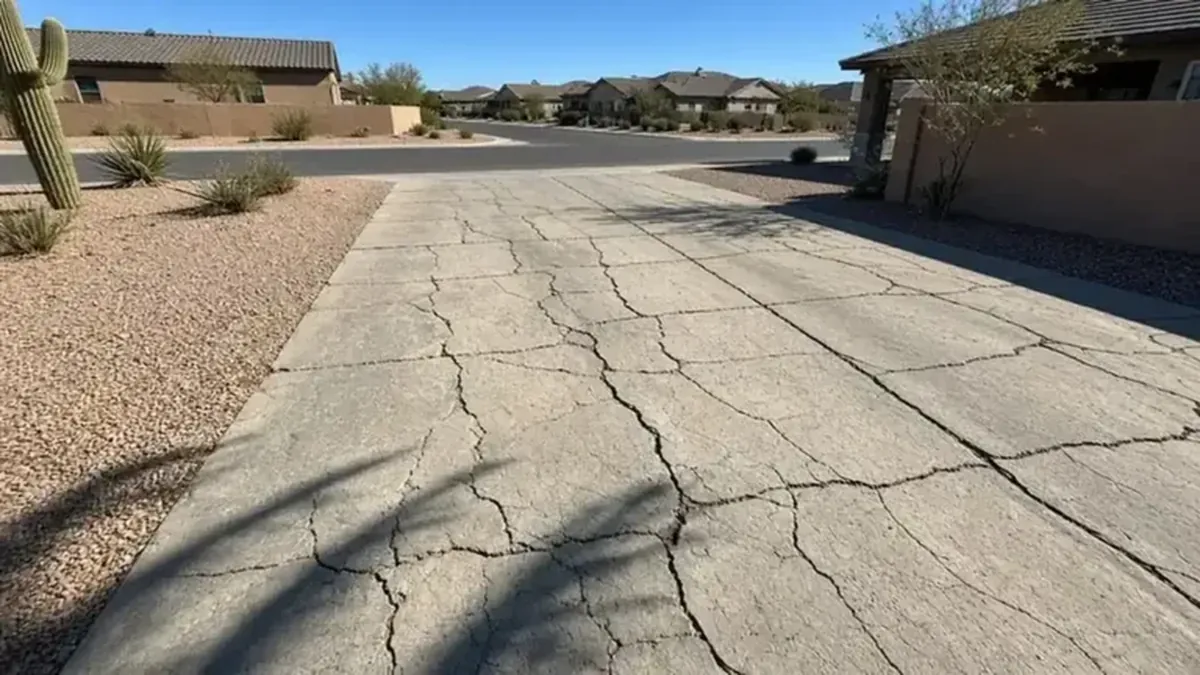
New Concrete Cracked: Is It Normal and Who Pays?
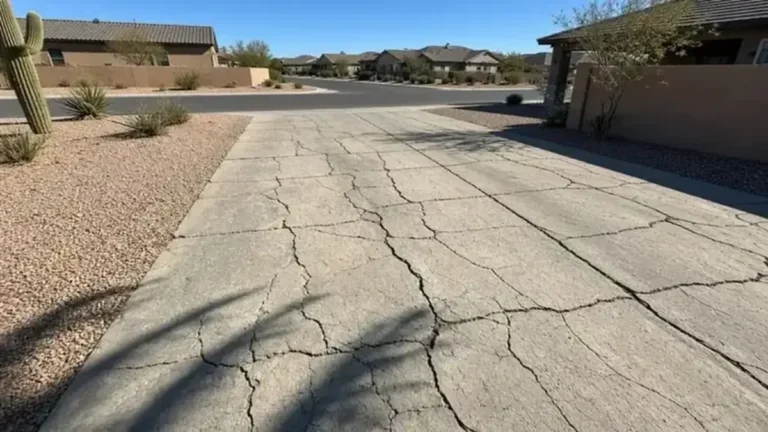
Yes — new concrete can develop cracks without automatically meaning the slab failed or that the contractor did poor work. Concrete shrinks as it loses moisture and can crack when that movement is restrained. Industry guidance is clear that completely crack-free concrete is not a realistic expectation for most slabs.
That does not mean every crack should be ignored. Some early cracks are ordinary shrinkage. Others widen, offset, or track drainage and support problems and deserve a closer look. Responsibility — who pays for repair or replacement — depends on cause, the written contract and warranty, workmanship, site conditions, maintenance, timing, and evidence. It cannot be determined from appearance alone.
This article is general educational information, not legal advice.
Quick answer: what am I looking at?
This table is a starting point for conversation and documentation — not a remote diagnosis.
| Situation | Usually concerning? | Possible next step |
|---|---|---|
| Fine hairline crack, sides level, little change over time | Often lower concern | Photograph, monitor, note pour date and first appearance |
| Crack following a control joint | Often expected | Confirm it stays within the joint; document width over time |
| Crack appears within hours/days of the pour | Needs context | Note weather/curing; ask contractor what was observed during placement |
| Crack widening over weeks | Higher concern | Document dates/photos; discuss cause with contractor |
| Vertical displacement / trip edge | Higher concern | Restrict use if unsafe; seek prompt evaluation |
| Settlement, rocking slab, or soft/ponding edges | Higher concern | Check drainage and support; evaluate repair vs replace |
| Water entering crack or ponding on/near slab | Context-dependent | Improve drainage notes; evaluate durability and base risk |
| Crack reopens after a repair | Higher concern | Reassess cause before repeating the same fix |
Why new concrete cracks
Fresh and young concrete can crack for several reasons:
- Plastic shrinkage while the concrete is still plastic, when surface water evaporates faster than bleed water can replace it — more likely in hot, dry, or windy placements common around Phoenix.
- Drying shrinkage after hardening, as moisture leaves and the slab tries to shorten against friction or adjoining restraints.
- Thermal movement and other restraint from geometry, edges, or embedded items.
- Curing and finishing conditions that leave the surface unprotected when evaporation is high.
- Joint layout that does not give shrinkage a planned place to occur.
- Base movement from settlement, washout, or soil moisture change.
National ready-mix guidance notes both that crack-free concrete is not generally achievable and that practices such as jointing, subgrade preparation, finishing timing, moisture protection, and curing help reduce and control cracking. Wire mesh or ordinary reinforcement does not prevent cracks; when placed correctly it can help keep crack widths smaller.
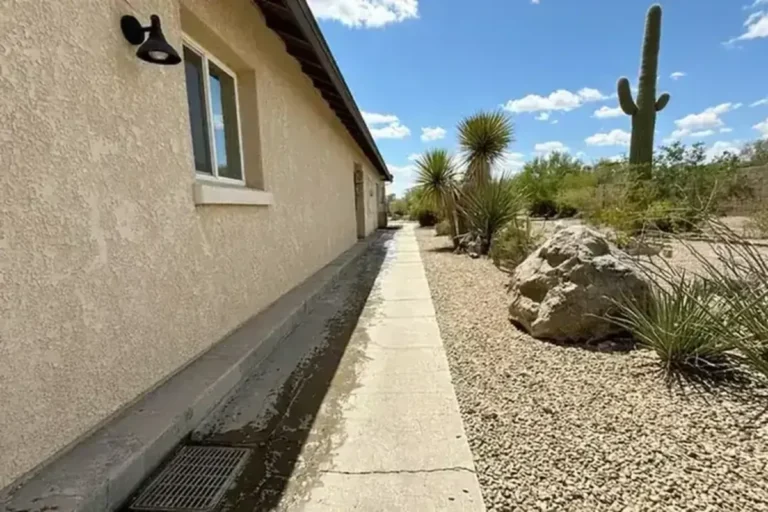
For a fuller Phoenix-focused explanation of heat, monsoon moisture, soils, drainage, joints, and reinforcement, see Why Concrete Cracks in Phoenix: Heat, Monsoon and Soil Explained.
Are hairline cracks normal?
Often, a fine hairline crack in newer concrete is consistent with shrinkage — especially if the edges stay flush, the crack is not growing quickly, and there is no rocking or settlement. Cracks that form in sawed or tooled control joints are frequently intentional: the joint is a planned weak plane so the slab cracks there instead of randomly across the panel.
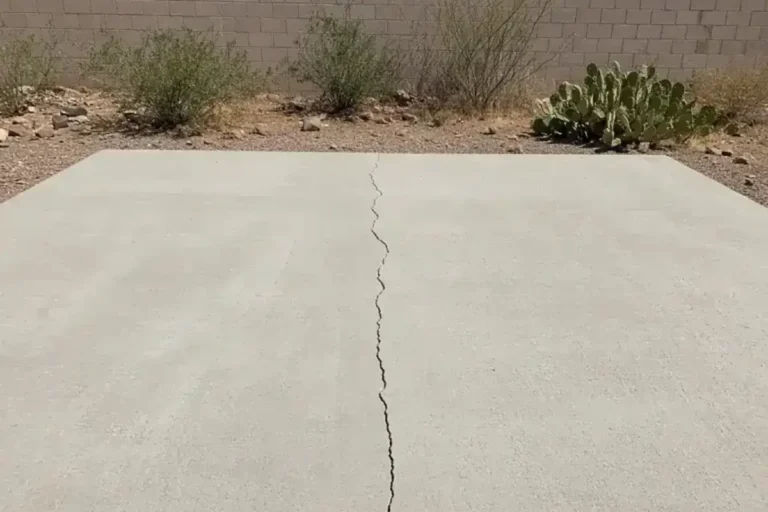
Still, “hairline” is not a magic word. Timing, location, stability, water entry, and whether the sides remain level all matter. Do not rely on a single universal width limit from a blog post. Arizona’s Registrar of Contractors publishes Minimum Workmanship Standards that include numeric concrete tolerances used in agency workmanship discussions (for standard finishes). Those references can inform a professional review, but they are not a substitute for looking at the whole slab, the contract, and the site.
Cracks that deserve closer inspection
These signs do not prove defective work, but they justify closer evaluation:
- Widening over time
- Vertical offset between the two sides
- Rocking or hollow-sounding areas
- Settlement or heaving
- Multiple connected cracks forming a pattern of movement
- Repeated reopening after patching
- Poor drainage, edge washout, or soft support
- Trip hazards or safety concerns
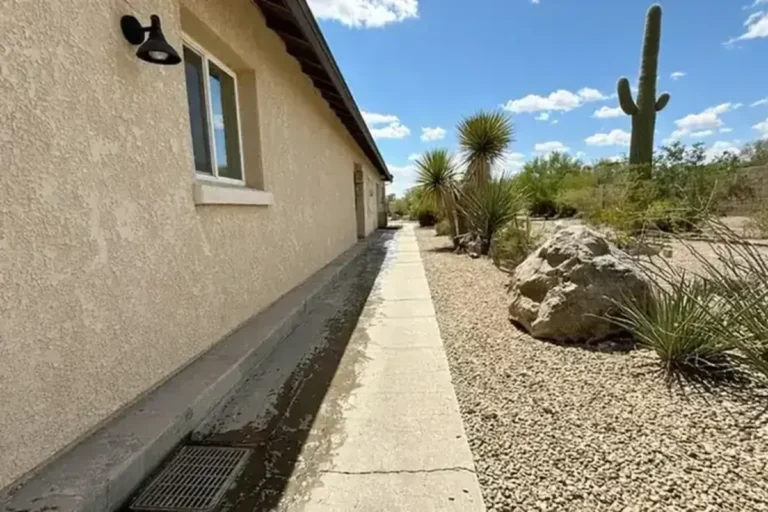
If irrigation changes, new landscaping grades, or blocked drains appeared after the pour, include that in your notes. Support and moisture conditions can drive cracking even when the concrete mix itself was placed carefully.
Does cracking mean poor workmanship?
Sometimes workmanship or construction practice contributes — for example through inadequate curing or moisture protection in hot weather, poor joint layout or timing, weak or uneven base preparation, finishing while bleed water is still present, or a thickness/design that does not match the intended load. Industry references list those as common contributors when cracking becomes excessive or poorly controlled.
At the same time, shrinkage and restraint can produce cracks even when workmanship is acceptable. A crack is a signal to investigate cause, not an automatic verdict. Fair evaluation looks at what the contract required, what was built, how the slab was cured and jointed, how the site drains, and how the slab has been used and maintained.
Who pays for cracked new concrete?
There is no single answer that fits every driveway, patio, or slab.
Possible outcomes include:
- Contractor responsibility where workmanship, scope, or warranty terms support a remedy after the cause is understood.
- Homeowner / site-condition responsibility where post-pour drainage changes, abnormal use, or excluded conditions are the driver.
- Shared or uncertain cause where evidence is mixed and more evaluation is needed.
- Warranty coverage for some items and exclusions for others (shrinkage language, acts of God, owner maintenance, and similar clauses vary by contract).
- Third-party factors such as utility work, adjacent construction, or irrigation failures.
Phoenix Concrete Contractors cannot determine legal liability from a photo or a phone call. An on-site look at the visible condition can help discuss practical repair or replacement options; it is not a legal ruling.
Check the contract and warranty
Before assuming who pays, gather and read:
- Written scope of work
- Specified thickness, reinforcement, and base preparation
- Jointing and curing expectations, if listed
- Drainage responsibilities
- Warranty length, covered items, and exclusions
- Required notice procedures and repair/remedy terms
- Change orders and messages that altered the original scope
If something important was only discussed verbally, note that gap. Written terms are usually the best starting point for understanding the agreed scope, warranty, and remedy process.
Arizona contractor complaint / ROC options
If you hired a licensed Arizona contractor and you believe the work may not meet professional workmanship or applicable standards, the Arizona Registrar of Contractors investigates written complaints. Current ROC guidance and A.R.S. § 32-1162 describe filing windows that are generally two years — for new construction, measured from the earlier of close of escrow or actual occupancy; for other projects (including remodel and repair work), from completion of the specific project. The ROC complaint page also describes remodel/repair timing from when work was last performed. Confirm the current rule for your situation on roc.az.gov or with qualified counsel; this is not legal advice.
At a high level, the ROC process typically involves a complete written complaint with supporting documents, investigator review, and often a jobsite inspection comparing listed items to minimum industry standards. Outcomes can include dismissal, a written directive to correct issues, further compliance review, or escalation through the agency’s legal process. A Residential Contractors’ Recovery Fund claim, when applicable, is a separate filing — not automatic.
Talking with the contractor first, with clear documentation, is still a sensible first step in many cases. Filing with the ROC is an option when the situation warrants a formal regulatory complaint — not a required first move for every hairline crack.
What to document
Create a simple folder (phone album + PDF/paper copies) with:
- Pour date and address/location of the slab
- Date the crack was first noticed
- Dated photos from multiple angles (include a wide shot and a close-up)
- Occasional ruler or coin reference photos if helpful
- Notes on whether the crack grew, offset, or stayed stable
- Weather, irrigation, or drainage events around the same time
- Contract, estimate, invoices, warranty
- Emails, texts, and notes from conversations
- Any repair attempts and results
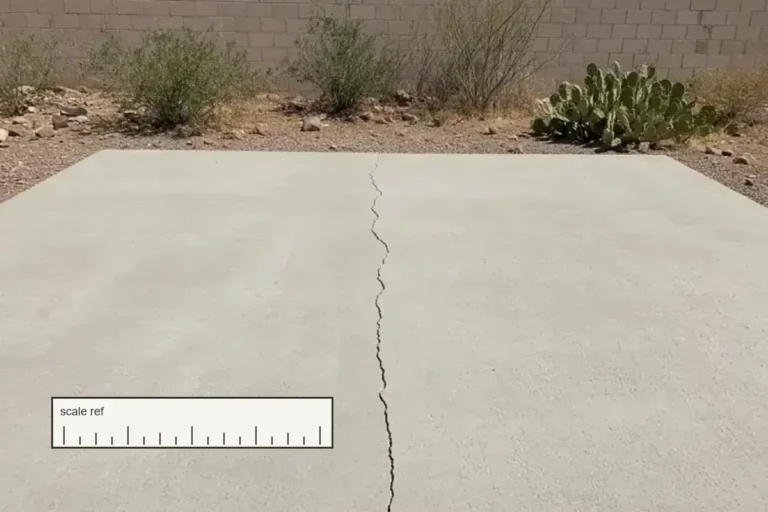
Good records help everyone — homeowner, contractor, and any later reviewer — discuss facts instead of memories.
Talk to the contractor first
Contact the contractor calmly and factually. Share:
- Where the crack is
- When it appeared
- Whether it has changed
- Whether there is offset, rocking, or drainage involvement
- Photos and pour/warranty dates
Ask what they observe as the likely mechanism, what the warranty or scope says, and what monitoring, repair, or further evaluation they recommend. Avoid accusations until the cause is better understood. Most productive outcomes start with shared facts.
Repair options
Depending on cause and condition, next steps may include:
- Monitoring a stable hairline crack
- Sealing to limit water entry
- Crack repair suited to the crack type
- Partial replacement of a failed panel or edge
- Full replacement when movement, base failure, or safety issues make repair impractical
Do not choose a treatment from a photo online. Cause drives the method. For condition assessment and repair options on existing flatwork, see concrete repair in Phoenix. If replacement of a driveway is on the table, budgeting context is covered in our concrete driveway cost guide. Related surfaces are covered on concrete driveways and concrete patios.
When to consider independent evaluation
Consider a qualified independent professional (for example a licensed engineer or other appropriately credentialed evaluator) when:
- You and the contractor disagree about cause
- Movement appears near a structure or foundation edge
- Repairs keep failing
- Settlement or offset is substantial
- The dispute involves significant cost
- Safety is in question
Phoenix Concrete Contractors provides contracting services and on-site evaluation of visible concrete condition. We do not provide engineering certifications or legal determinations.
FAQ
Is cracking normal in new concrete?
Some cracking is common because concrete shrinks and is usually restrained. Completely crack-free slabs are not a realistic industry expectation. The question is whether the crack’s size, movement, and cause are acceptable for that slab.
How soon can new concrete crack?
Plastic-shrinkage cracks can appear while concrete is still plastic or very soon after placement. Drying-shrinkage and support-related cracks can appear later as the slab loses moisture or the base moves.
Are hairline cracks a defect?
Not automatically. Many hairline cracks are shrinkage-related. Stability, offset, location, water, and contract/warranty language all matter. Appearance alone does not decide defect status.
Should my contractor fix cracks?
Maybe — depending on cause, scope, warranty, and applicable workmanship standards. Ask for a cause-based explanation and read the written terms. There is no universal “contractor must fix every crack” rule from a photo.
Does concrete have a warranty against cracks?
Only as written. Some warranties address workmanship; many limit or exclude certain shrinkage or site-condition issues. Read exclusions and notice requirements carefully.
Can new concrete cracks be repaired?
Often yes, when the slab and base are otherwise sound and the cause is addressed or accepted. Repair method depends on crack type and movement.
When should concrete be replaced?
When movement is widespread, offsets create hazards, the base has failed, or repairs would not restore safe, useful service.
Can I file an Arizona ROC complaint?
Homeowners who used a licensed contractor may be able to file a written complaint with the Arizona Registrar of Contractors within the statutory time limits. Confirm current procedures and deadlines on roc.az.gov. This is not legal advice.
Need a practical next step in Phoenix?
If you have cracked concrete in Phoenix and need help understanding whether repair or replacement may be practical, contact Phoenix Concrete Contractors for an on-site evaluation of the visible condition. ROC #684568 · Founded 2016 · (928) 470-8580.