Why Concrete Cracks in Phoenix: Heat, Monsoon and Soil Explained
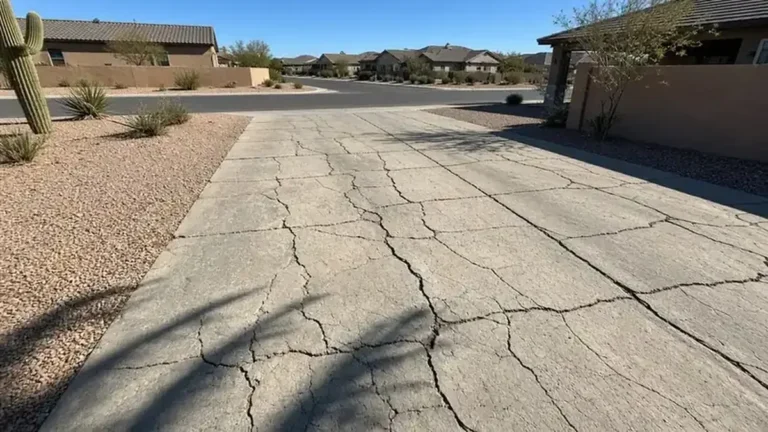
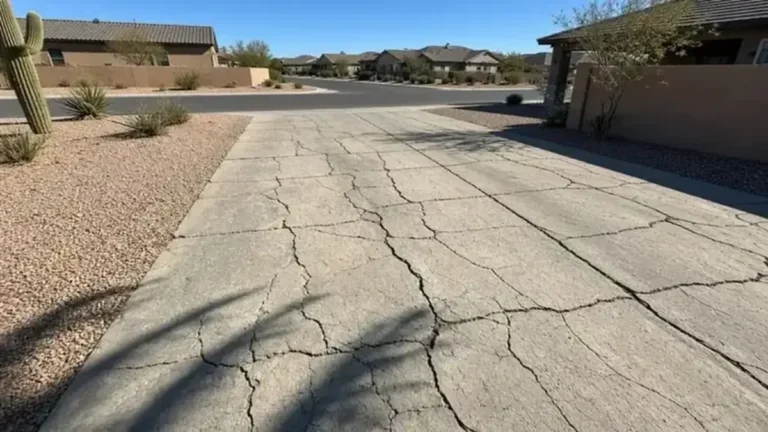
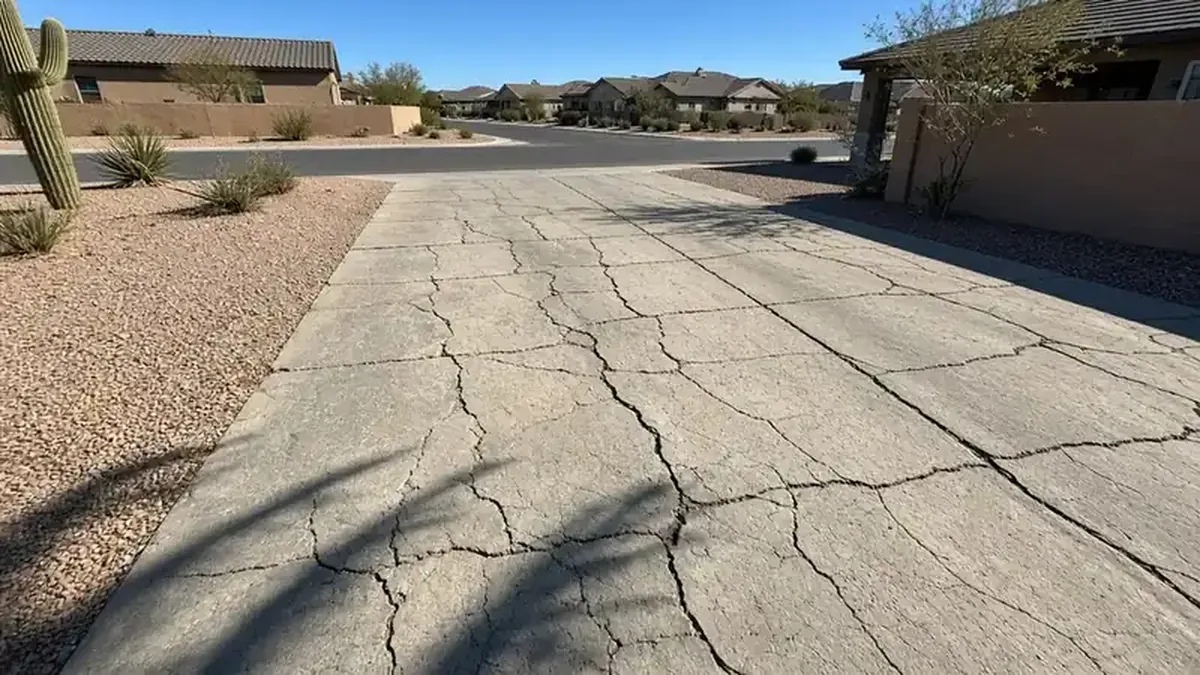
Concrete can crack for several reasons, and not every crack means the contractor failed or the slab is structurally unsafe. Concrete is strong in compression and relatively weak in tension. When the surface or the slab as a whole is pulled tighter than it can stretch — by shrinkage, temperature change, movement underneath, or load — a crack can form.
In Phoenix, those behaviors meet a demanding climate: extreme summer heat, fast surface drying, monsoon moisture cycles, and soil and drainage conditions that vary from lot to lot. Knowing the main causes helps you decide what to monitor, what to repair, and when to get an on-site look — without treating every hairline as a disaster. If your concrete is newly poured and already cracked, see whether new concrete cracking is normal and who may be responsible.
Quick answer: common causes at a glance
This table is educational, not a remote diagnosis. The same looking crack can have different causes on different properties.
| Cause | What happens | Typical signs | What to do |
|---|---|---|---|
| Plastic shrinkage | Surface dries faster than bleed water can replace it while concrete is still soft | Early, shallow, often roughly parallel cracks soon after placing | Note timing; ask about curing/placement; seal/monitor as advised |
| Drying shrinkage | Hardened concrete loses moisture and shortens against restraint | Hairline to fine cracks, often random or between joints | Usually monitor if stable; joints should “take” most shrinkage |
| Thermal movement | Hot days and cooler nights expand/contract the slab | Fine cracks; movement at joints; more noticeable on long exposed slabs | Maintain joints/sealant; reduce ponding that worsens support change |
| Settlement / base issues | Support softens, erodes, or was never uniform | Wider cracks, rocking, low spots, edge drop | Evaluate base/drainage; repair or replace based on extent |
| Soil moisture change | Some soils swell when wet and shrink when dry | Seasonal movement, heave/drop, cracks that open and close | Improve drainage/watering; get site evaluation if progressive |
| Poor drainage / water | Water under or beside the slab changes support | Soft edges, washouts, staining, cracks near low grades | Fix grading/drainage first; then address concrete |
| Missing/poor joints | Shrinkage has no planned place to crack | Random map cracking instead of clean joint lines | Repair depends on stability; future work needs joint planning |
| Curing / early drying | Surface loses moisture too fast after finishing | Early map or crazing; weaker surface feel | Protect/cure new work; evaluate older surfaces case by case |
| Load stress | Slab thinner or weaker than the load needs | Cracks under wheel paths, corners, or heavy parking areas | Match thickness/support to use; repair or replace as needed |
Why concrete naturally shrinks
Fresh concrete contains more water than the hardened paste will permanently hold. As cement hydrates and excess water leaves, the paste contracts.
Plastic shrinkage happens before the concrete has set. If wind, heat, and dry air pull moisture off the surface faster than bleed water rises, the top layer can shrink while the concrete underneath still restrains it. Industry guides such as NRMCA CIP 5 describe this as a classic flatwork risk — especially in hot, windy, low-humidity conditions.
Drying shrinkage happens after hardening. As the slab continues to dry, it wants to get slightly shorter. Anything that holds it in place — friction on the base, adjoining concrete, shapes and returns, or embedded steel — creates tension. ACI guidance on drying-shrinkage cracking notes that some cracking is expected in many restrained members; the practical goal is control, not perfection.
That is why a well-built driveway or patio can still show fine cracks over time. Crack-free residential flatwork is not a realistic promise in Phoenix — or almost anywhere else.
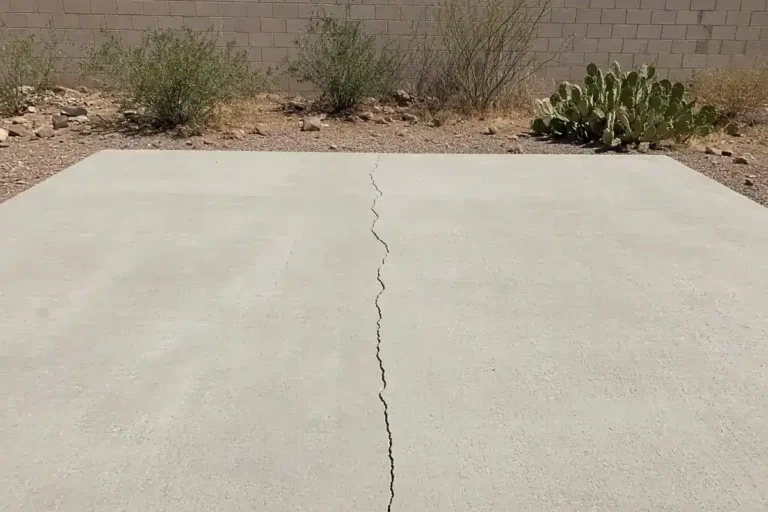
Phoenix heat and rapid drying
Phoenix-specific fact: Using 1991–2020 climate normals compiled by the Arizona State Climate Office, Phoenix’s July mean maximum is about 106.5°F, and June through August mean maxima stay above 100°F. Surfaces in full sun get hotter still.
General concrete principle: High concrete and air temperatures, low relative humidity, and wind raise the evaporation rate from fresh concrete. ACI hot-weather concreting guidance associates arid conditions with higher plastic-shrinkage risk and stresses planning for protection during placing and curing. In that industry guidance, when the estimated evaporation rate approaches about 0.2 lb per square foot per hour, precautions against plastic-shrinkage cracking are recommended (for example fogging, windbreaks, sunshades, evaporation retarders, and prompt curing). That figure is a planning and precaution indicator from hot-weather practice — not a universal crack threshold, not a Phoenix code limit, and not a guarantee that cracking will or will not occur.
Heat alone does not mean every crack is a hot-weather failure. Many older slabs crack from shrinkage, settlement, or loads years later. Still, Phoenix summers make early moisture loss a real placement risk — crews plan around it with timing, moisture control, and curing that keeps the surface from baking dry in the first hours and days.
Monsoon moisture and drainage
Phoenix-specific fact: National Weather Service offices in the Southwest define monsoon season as June 15 through September 30. Storms can deliver intense rainfall after long dry stretches.
Rain does not usually “split” a sound, well-supported slab the way a freeze might elsewhere. The more common monsoon-related problems are support and moisture change:
- Water that ponds against or under a slab
- Poor grading that drives runoff under edges
- Erosion or washout of base material
- Repeated wetting and drying of soils that change volume
City of Phoenix lot-grading policy emphasizes draining water away from foundations — including substantial fall in the first 10 feet where feasible and sloping nearby impervious surfaces away from the building. That same drainage mindset matters for driveways and patio slabs: keep water moving to the right place, not into the base.
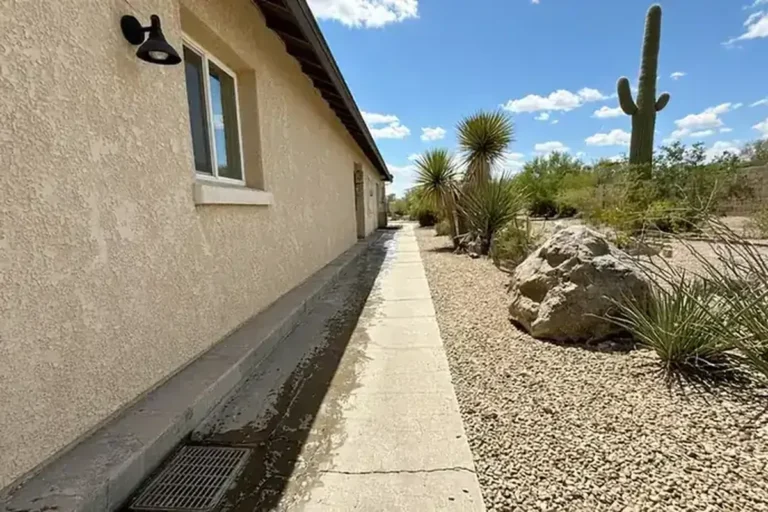
Phoenix soil conditions — important, not universal
Phoenix-specific fact: Arizona Geological Survey materials describe both expansive (shrink/swell) clays and collapsing soils in the state. NRCS soil surveys and Phoenix-area engineering studies show shrink-swell potential varies across the Valley — high in some neighborhoods, moderate or low in others.
General concrete principle: A slab is only as stable as the support under it. Soft fill, poor compaction, organic pockets, or washed-out base can settle. Where expansive clay is present, moisture changes can heave or drop support. Where collapsing soils are present, wetting under load can densify the ground suddenly.
Do not assume every Phoenix crack is “expansive soil.” Many lots perform well with ordinary base preparation and drainage. Fill quality, irrigation, and grading often matter as much as a soil-map label. Progressive movement — especially near foundations — may warrant a geotechnical look; flatwork decisions still start with elevation change, rocking, and drainage.
Control joints: managing where cracks appear
Control joints (contraction joints) are planned weak lines. They do not make concrete crack-proof. They give shrinkage a preferred place to relieve stress so cracks are more likely to follow a straight, maintainable line instead of wandering across the middle of a panel.
Industry slabs-on-ground guidance treats joint layout as a design and workmanship tool. Exact spacing depends on thickness, mix, restraint, and exposure. Publishing a single “every X feet” rule as a Phoenix law would overstate the case. What homeowners should expect is intentional jointing that matches the slab’s shape and use — and an understanding that some panels can still show incidental cracks even when joints are present.
Reinforcement: helpful, not crack-proof
Rebar, welded wire, and fibers are often marketed as if they stop cracking. In typical slabs-on-ground, that is not how ACI describes ordinary reinforcement.
General concrete principle: Distributed reinforcement is commonly used to help control crack width and keep sections tied together after a crack forms. ACI 360R-type guidance is clear that ordinary reinforcement does not prevent shrinkage cracking; systems intended to largely prevent shrinkage cracking (such as certain post-tensioned or shrinkage-compensating approaches) are different designs.
For homeowners: reinforcement can be valuable for load transfer and crack control, especially on concrete driveways and slabs and foundations that see traffic or longer spans. It is not a warranty that the surface will stay unmarked.
Settlement and base failure
Cracks that open with a step, a rock, or a hollow sound often point under the slab rather than only at the paste. Common contributors include:
- Soft or poorly compacted fill
- Base washed out by roof drains, irrigation, or monsoon flow
- Plumbing or irrigation leaks
- Tree roots lifting or drying soils unevenly
- Uneven support at thick/thin transitions or against older concrete
Fixing only the crack while water still softens the base usually means the crack returns. Drainage and support come first; then concrete repair or replacement can be planned honestly.
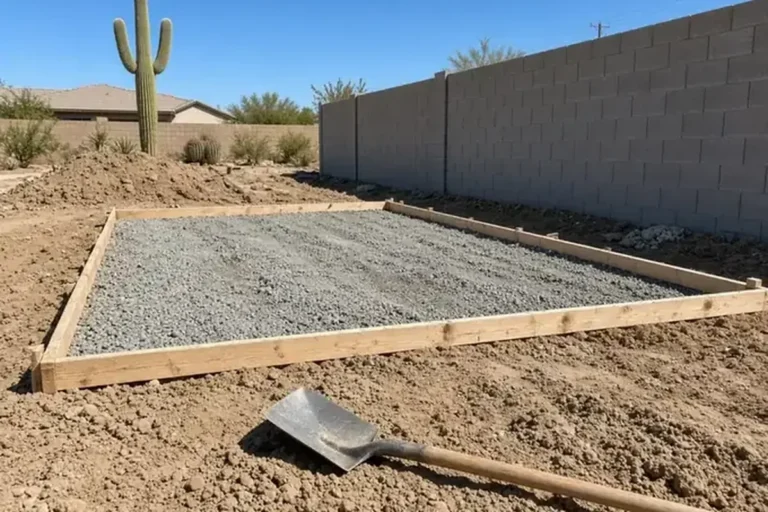
Load-related cracking
Passenger cars on a properly supported residential slab are a different demand than RVs, trailers, delivery trucks, or shop equipment. Cracks along wheel paths, corners that break under turning loads, or slabs that were poured thin for the real use often need a conversation about thickness and support — not just a surface filler.
City of Phoenix driveway policy calls for 6-inch residential concrete in the right-of-way contexts it covers. Private-property design still needs to match the vehicles you actually park. If you are budgeting a new or replacement driveway, see our guide to concrete driveway cost in Phoenix for how thickness, demo, and access affect price.
Normal vs concerning cracks
Usually monitor (if stable):
- Fine hairline cracks that do not grow season after season
- Shrinkage cracks that stay flush (no vertical offset)
- Cracks that follow or stay near control joints
- Early plastic-shrinkage lines that remain shallow and unchanged
Needs closer evaluation:
- A crack that keeps widening
- Vertical displacement (one side higher than the other)
- Rocking slabs or soft spots
- Water actively entering or pumping under the surface
- Trip hazards
- Multiple panels moving together
- Cracks tied to obvious washout, plumbing leaks, or foundation symptoms
These signs do not prove structural failure, but they are reasons to have the slab evaluated. Patios, driveways, and house-adjacent flatwork deserve different urgency when movement affects entries, drainage, or safety.
Repair or replace?
Repair may make sense when damage is localized, the slab is still reasonably supported, drainage can be corrected, and the remaining concrete is sound enough to hold a repair.
Replacement may be more practical when large areas have moved, elevation differences are significant, the base has failed across much of the slab, or repeated repairs keep failing.
Good concrete repair starts with cause, not only cosmetics. Filling a settlement crack without fixing washout is temporary. Replacing a mostly stable slab for a few hairlines can be unnecessary. An on-site inspection is how you sort those apart.
Reducing risk on new Phoenix concrete
You cannot promise crack-free concrete. You can reduce risk:
- Uniform, well-compacted base and suitable fill
- Grades that move monsoon and irrigation water away from edges
- Slab thickness and detailing matched to real loads
- Thoughtful joint layout for the panel sizes and shape
- Hot-weather placement practices and real curing
- Realistic expectations: joints and fine cracks are part of how flatwork lives in the desert
FAQ
Why does new concrete crack?
New concrete can show plastic-shrinkage cracks within hours or drying-shrinkage cracks as it hardens and loses moisture. Restraint and weather during placement both matter. Some fine cracking can occur even on carefully placed work.
Are hairline cracks normal?
Often yes, especially if they are stable, flush, and not tied to settlement. Monitor them. Growing offset cracks are a different category.
Does Phoenix heat cause concrete to crack?
Heat raises evaporation and thermal movement risk, especially during placement and early curing. Heat is one factor among several — not a universal label for every crack you see years later.
Can monsoon rain damage concrete?
Rain more often damages support through ponding, erosion, and soil moisture change than by “breaking” sound concrete on contact. Drainage is the practical focus.
Do control joints prevent cracking?
They manage where shrinkage cracks are encouraged to form. They do not make concrete immune to cracking.
Can cracked concrete be repaired?
Many cracks can be improved or stabilized when the slab and base are otherwise sound. Others need partial or full replacement after the cause is addressed.
When should concrete be replaced?
When movement is widespread, offsets are significant, the base has failed, or repairs would not restore safe, useful service.
Talk through your options
If you have cracked concrete and are unsure whether repair or replacement makes sense, Phoenix Concrete Contractors can inspect the condition and discuss practical options. We do not promise that every crack can be repaired — only that you will get a clear explanation of the visible condition and practical options.
Phoenix Concrete Contractors · ROC #684568 · Founded 2016 · (928) 470-8580 · Request an estimate