Licensed Arizona Concrete Contractor · Founded 2016
Driveway Permits and Right-of-Way Rules in Phoenix
The City publishes a Driveway Policy for Single Family Development , document TRT/DOC/00071, revised 03/26. It says City Code Section 31-44 controls access to public streets from driveways. The City’s Street Planning and Design Guidelines also provide design parameters.
Credential
Licensed AZ Contractor
Tenure
Founded 2016
Roots
Local Phoenix Team
Upfront
Free Estimates
Climate Spec
Heat, Monsoon & Soil
Proven Arizona Heritage
Serving Phoenix property owners since 2016
What does the City’s driveway policy cover?
The City publishes a Driveway Policy for Single Family Development, document TRT/DOC/00071, revised 03/26. It says City Code Section 31-44 controls access to public streets from driveways. The City’s Street Planning and Design Guidelines also provide design parameters.
The policy helps designers and reviewers handle residential driveway access on every kind of street. It was written with curb and gutter in mind. It also explains what to do when the street has none.
What the right-of-way is
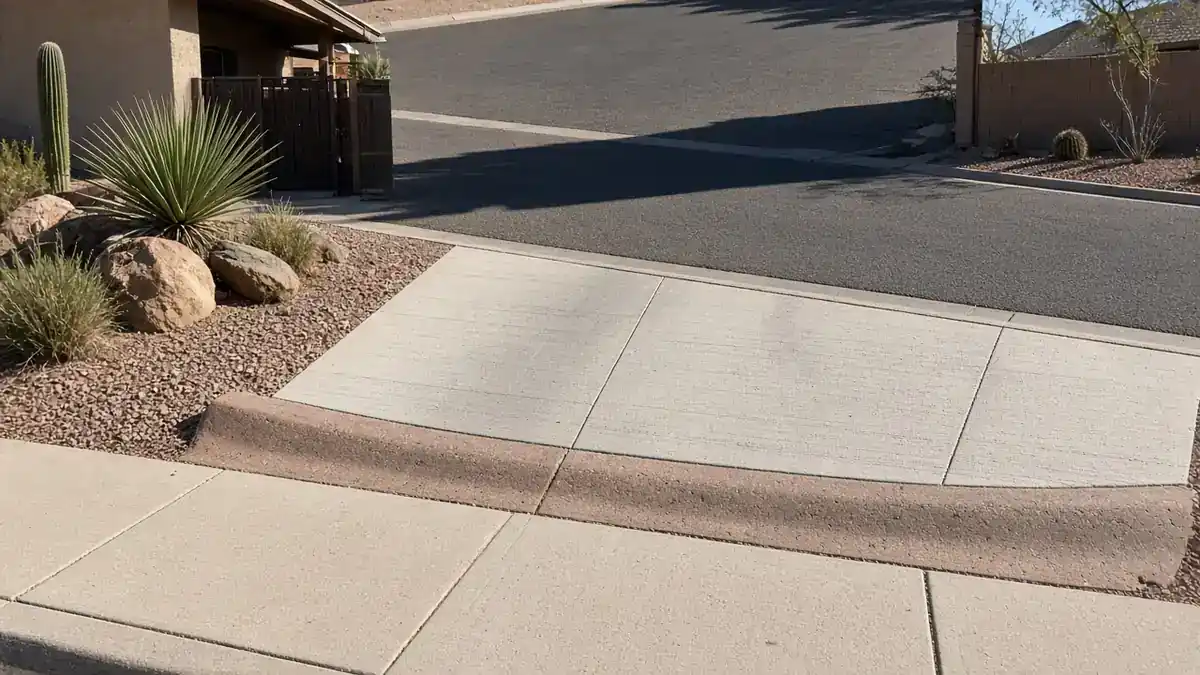
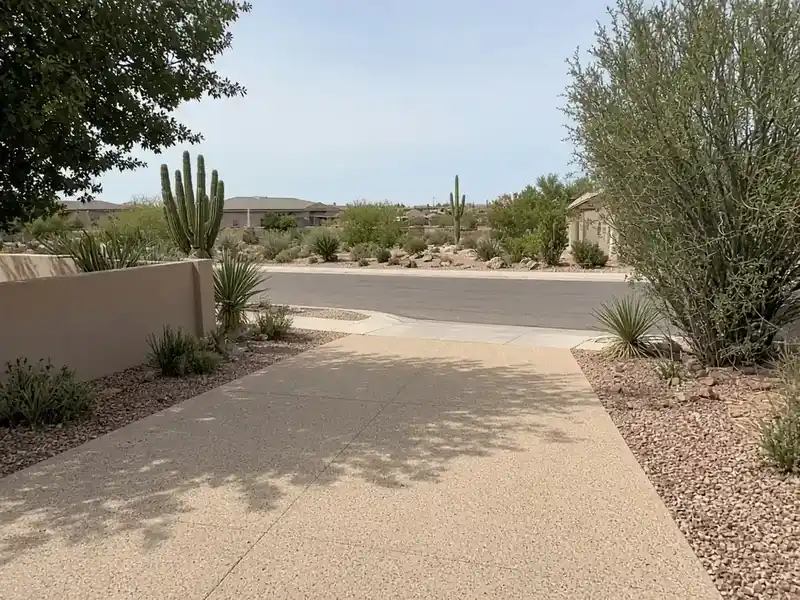
The right-of-way is the strip of public land along your street. It often includes the road, the curb, the sidewalk and a margin of land beside them. Your property line sits behind it. A driveway has a private part on your lot and a public part in the right-of-way.
The City measures the public part as a length. Per the policy, you measure perpendicular to the road’s direction of travel. Start at the existing concrete or asphalt and stop at the property line. That distance is the portion in the right-of-way.
What is the 10.5-foot rule?
The policy sets 10.5 feet as the length threshold. Take a road with roll curb or ribbon curb and gutter. A concrete driveway in the right-of-way up to 10.5 feet long counts as incidental to on-site driveway construction. That part needs no permit.
A driveway longer than 10.5 feet in the right-of-way needs its own permit.
Many homes fall under the limit. Some, with wide setbacks or unusual street layouts, do not. We measure before we quote.
What the City requires for materials and finishes
The policy sets standards for what goes in the right-of-way.
Concrete
Residential driveways use Class A concrete, 6 inches thick.
Finish
Say a section runs longer than 10.5 feet in the right-of-way. A material other than concrete or asphalt needs a maintenance agreement. So does a concrete finish other than rough broom.
The City’s Street Transportation Department issues it. That includes stamped and decorative finishes. Plan the finish before you plan the pour (see stamped concrete).
Gravel
Single-family detached homes with existing curb and gutter may have a gravel driveway in the right-of-way without a permit. The material must be aggregate base course, crushed rock or gravel in a set size range. Construction follows MAG Detail 202 and Specifications 310 and 702. The gravel needs dustproofing, such as Marloc, Soil Sement or another environmentally friendly product.
Asphalt
Where asphalt is used, the policy points to MAG Standard Detail 202.
What if your street has no curb or sidewalk?
Some streets, often in rural-style parts of the city, have no sidewalk and no curb and gutter. For those, the policy requires an at-grade driveway tie-in, built to MAG Standard Detail 205 for paved turnouts. A permit is required.
The policy also calls for an off-site flow analysis and erosion protection. Water must be handled, not just moved. The 6-inch Class A concrete rule applies. So does the maintenance agreement for other materials or finishes once the right-of-way section passes 10.5 feet.
Street types overlap, and exceptions exist. Confirm which category you fall into.
How to find out what applies to your property
01
Look at your street
Is there a sidewalk, a curb and gutter, or a ribbon or roll curb?
02
Measure the right-of-way section
Use the City’s rule: from the existing pavement edge to the property line.
03
Decide your materials and finish
Plain concrete with a rough broom finish is the simplest.
04
Contact the City
The policy lists Planning and Development at 602-262-7811 (voice, or 7-1-1 for TTY). Revocable permits and maintenance agreements are handled through the City’s special permits page.
05
Share the answer with your contractor
We build to what the City requires.
We do not state fees here, because they change.
How widening changes the permit question
Widening usually touches the right-of-way, especially if it changes the width of the curb cut. A wider driveway adds paving, and that can change the length, the finish rules and the drainage. Widening can require a permit, so ask first. See concrete driveways.
What else to check before you pour
HOA approval
An HOA may review width, color and materials. Ask for your architectural guidelines, because approval can take weeks. City approval does not replace HOA approval.
Utilities
Arizona 811 must mark underground lines before anyone digs. Call at least two full working days ahead. Marks last 15 working days.
Dust
Maricopa County’s Rule 310 covers dust from construction and earth-moving.
Contractor license
In Arizona, a licensed contractor shows the ROC number on bids and contracts. Check any license with the Arizona Registrar of Contractors.
Drainage
The National Weather Service counts monsoon season from June 15 to September 30. A driveway should send water away from the house and not onto a neighbor. The City’s flow analysis rule reflects that.
What happens if you skip the permit
If a permit is required and you skip it, you risk having to correct the work at your own cost. The City may require changes. Check with the City for the details of enforcement. A contractor who tells you to skip a permit is a red flag (see our hiring checklist).
Frequently asked questions
Get help with a driveway project
Send us your address and your plan. We will check the measurements and tell you what we see, then give you a free estimate.
Planning the budget for the pour itself? See our guide to concrete driveway cost in Phoenix.
Right-of-way driveway details